
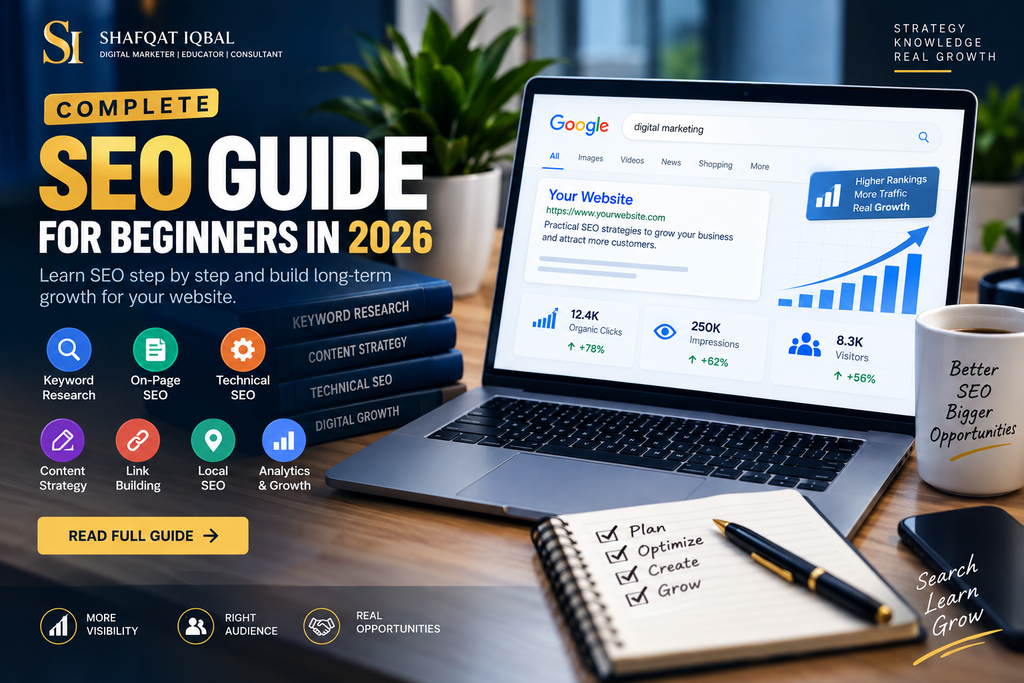
Search Engine Optimization (SEO) is one of the most important digital marketing strategies for businesses that want to build a strong and sustainable online presence.
When people search for a product, service, solution, or answer on Google, search engines try to show the most relevant and useful results. SEO helps your website and content become easier for search engines to understand while also creating a better experience for visitors.
The good news is that you do not need to be an SEO expert to get started. By understanding the fundamentals, creating useful content, optimizing your website, and consistently improving your strategy, you can build a strong SEO foundation.
In this complete beginner’s guide, we will cover keyword research, search intent, on-page SEO, technical SEO, content strategy, link building, local SEO, performance measurement, and common SEO mistakes.
What Is SEO?
SEO stands for Search Engine Optimization.
It is the process of improving a website and its content so that search engines can better understand, discover, and present it for relevant searches.
For example, if you provide digital marketing services, potential clients may search for:
- Digital marketing services
- SEO services
- SEO consultant
- Social media marketing services
- Digital marketing consultant
A well-optimized website can help search engines understand what your business offers and which searches your pages may be relevant to.
SEO is not simply about adding keywords to a webpage. Modern SEO involves content quality, search intent, website structure, technical performance, user experience, authority, and continuous optimization.
Why Is SEO Important for Businesses?
A strong SEO strategy can help businesses become more discoverable when potential customers are actively searching for information, products, or services.
- Increase Organic Visibility
SEO can help your pages appear in relevant search results without requiring you to pay for every individual click.
- Attract Relevant Visitors
Good SEO focuses on attracting people who are actually interested in your topic, product, or service.
- Build Brand Awareness
Consistently appearing for relevant searches can increase awareness of your brand and expertise.
- Create Long-Term Content Assets
A useful article can continue attracting visitors after it has been published, although performance can change over time.
- Support Business Growth
When SEO traffic is aligned with the right audience and conversion strategy, it can contribute to enquiries, leads, sales, and other business objectives.
Understand Search Intent
Before creating content, you need to understand why someone is searching.
This is called search intent.
Informational Intent
The user wants to learn something.
Examples:
- What is SEO?
- How does SEO work?
- How to create a Facebook Ad?
Navigational Intent
The user is looking for a specific website or brand.
Examples:
- Google Search Console
- Canva
- Shafqat Iqbal Digital Marketing
Commercial Investigation
The user is researching options before making a decision.
Examples:
- Best SEO services for small businesses
- Best WordPress agency
- SEO tools comparison
Transactional Intent
The user is ready to take an action such as buying, booking, or signing up.
Examples:
- Hire SEO consultant
- Buy SEO software
- Book digital marketing consultation
The key principle is simple: create content that matches what the searcher actually wants.
Keyword Research
Keyword research helps you discover the words and phrases people use when searching for information related to your business.
Instead of choosing keywords only because they have high search volume, consider:
- Relevance
- Search intent
- Competition
- Business value
- Topic depth
- Audience needs
Example
Suppose your business offers SEO services.
A broad keyword could be:
SEO
More specific keywords might include:
- SEO services for small businesses
- SEO consultant in Lahore
- Local SEO strategy
- SEO for WordPress websites
- How to improve Google rankings
Longer and more specific phrases can be useful because they often reveal clearer search intent.
Create Topic Clusters
Instead of publishing random articles, organize your content around important topics.
For example, your main topic could be:
SEO
Supporting articles could include:
- Complete SEO Guide for Beginners
- Keyword Research Guide
- On-Page SEO Guide
- Technical SEO Basics
- Local SEO Guide
- SEO Content Strategy
- Link Building Guide
These related articles can be connected through internal links.
This creates a more organized content structure and helps visitors discover additional useful information.
On-Page SEO
On-page SEO refers to improvements you make directly to your webpage and content.
Important elements include:
SEO Title
Create a clear and relevant title that accurately describes the page.
Example:
Complete SEO Guide for Beginners in 2026
Headings
Use a logical heading structure:
H1: Main page title
H2: Major sections
H3: Supporting sections
Meta Description
Write a concise description that explains what the page offers and encourages relevant users to visit.
URL
Keep URLs short, descriptive, and readable.
Example:
/complete-seo-guide-for-beginners/
Internal Links
Link relevant pages together to help users discover additional information.
Image Optimization
Use descriptive filenames, appropriate image formats, suitable dimensions, and meaningful alternative text where appropriate.
Readability
Make your content easy to scan by using:
- Short paragraphs
- Clear headings
- Bullet points
- Examples
- Tables where useful
- Relevant images
A well-structured page is easier for both users and search engines to understand.
Technical SEO
Technical SEO focuses on how efficiently search engines can access, crawl, understand, and index your website.
Mobile Experience
Your website should work properly on smartphones, tablets, and desktop computers.
Page Performance
Large images, unnecessary scripts, and poorly optimized resources can negatively affect the user experience.
HTTPS
Your website should use a secure HTTPS connection.
XML Sitemap
An XML sitemap can help search engines discover important URLs on your website.
Robots.txt
The robots.txt file can provide crawling instructions to search engine crawlers.
Canonical URLs
Canonicalization helps communicate the preferred version of a page when similar or duplicate URLs exist.
Structured Data
Structured data can help search engines better understand certain types of content and may support eligible search-result enhancements.
Create Helpful Content
One of the most important parts of SEO is creating content that genuinely helps your audience.
Instead of writing an article simply to target a keyword, ask:
What problem is my audience trying to solve?
Then build the article around that problem.
Good content should be:
- Useful
- Original
- Accurate
- Well organized
- Easy to understand
- Relevant to the audience
- Updated when necessary
Examples of Valuable Content
Guides
Step-by-step educational resources.
Tutorials
Practical instructions for completing a task.
Case Studies
Detailed examples showing how a strategy or process worked.
FAQs
Answers to common questions from your audience.
Checklists
Simple resources people can use while completing a task.
Build a Content Strategy
Successful SEO usually requires consistency.
Create a content calendar based on your audience’s needs and your business goals.
For example:
Week 1: SEO Guide
Week 2: Meta Ads Guide
Week 3: Social Media Strategy
Week 4: AI Tools for Digital Marketing
You can also repurpose your blog content into:
- Instagram posts
- LinkedIn posts
- Facebook content
- YouTube videos
- Short-form videos
- Carousels
- Email newsletters
One strong article can become multiple pieces of content.
Internal Linking
Internal links connect one page of your website to another page on the same website.
For example, inside your SEO article you could link to:
Meta Ads Guide
or
Digital Marketing Strategy Guide
Internal linking can help:
- Visitors discover related content
- Create a logical website structure
- Distribute internal authority
- Guide visitors toward important pages
Always use relevant links where they genuinely help the reader.
Link Building
Links from other websites can be an important part of SEO.
However, the focus should be on quality, relevance, and natural acquisition rather than simply collecting a large number of links.
Potential approaches include:
- Creating original research
- Publishing useful resources
- Digital PR
- Industry partnerships
- Relevant guest contributions
- Creating content worth referencing
Avoid manipulative link schemes and low-quality link-building practices.
Local SEO
If your business serves a specific city or geographic area, local SEO can be particularly important.
For example:
Digital Marketing Consultant in Lahore
Local SEO can involve:
- Accurate business information
- Google Business Profile
- Local landing pages
- Location-relevant content
- Customer reviews
- Consistent business details across relevant platforms
The goal is to make it easier for people in your target area to discover and understand your business.
Measure Your SEO Performance
SEO should be measured rather than based on assumptions.
Useful data sources include tools such as Google Search Console and analytics platforms.
Monitor metrics such as:
- Organic clicks
- Search impressions
- Click-through rate
- Search queries
- Indexed pages
- Organic conversions
- Landing-page performance
Do not focus on rankings alone.
A page ranking well for an irrelevant keyword may bring little business value, while a smaller amount of highly relevant traffic can be much more meaningful.
Common SEO Mistakes to Avoid
Keyword Stuffing
Do not repeatedly insert keywords where they make the content unnatural.
Duplicate Content
Avoid publishing copied or substantially duplicated content across multiple pages.
Ignoring Search Intent
A page can target a keyword but still fail to satisfy what the searcher actually wants.
Poor Mobile Experience
If your website is difficult to use on mobile devices, visitors may leave quickly.
Slow Website
Large images and unnecessary scripts can hurt page experience.
Publishing Without a Strategy
Publishing dozens of unrelated articles does not automatically create a strong SEO strategy.
Ignoring Existing Content
Older content can sometimes be improved, updated, expanded, or consolidated instead of always creating new pages.
A Simple SEO Strategy for Beginners
If you’re just getting started, don’t try to optimize everything at once.
Follow this process:
Step 1 — Define Your Audience
Identify who you want to reach.
Step 2 — Understand Their Problems
Find the questions and problems your audience searches for.
Step 3 — Research Keywords
Identify relevant keywords and understand their search intent.
Step 4 — Create Useful Content
Write comprehensive content that genuinely answers the user’s question.
Step 5 — Optimize Your Pages
Improve titles, headings, URLs, images, internal links, and other relevant elements.
Step 6 — Improve Technical SEO
Make sure your website is accessible, secure, mobile-friendly, and technically sound.
Step 7 — Promote Your Content
Share useful content through relevant marketing channels.
Step 8 — Measure Results
Track traffic, impressions, clicks, conversions, and other meaningful metrics.
Step 9 — Improve
Use real performance data to identify opportunities.
Step 10 — Stay Consistent
SEO is an ongoing process. Keep creating, improving, testing, and learning.
Final Thoughts
SEO is not a one-time task or a shortcut to instant results. It is an ongoing process of understanding your audience, creating useful content, improving your website, building credibility, and learning from real performance data.
The best place to start is with a strong foundation.
Focus on:
Useful Content + Search Intent + Technical SEO + Good User Experience + Consistent Improvement
You don’t need hundreds of articles to begin. Start with a small collection of high-quality resources that genuinely answer the questions your audience is asking.
Over time, those resources can become an important part of your digital marketing ecosystem.
Ready to Improve Your Online Visibility?
A well-planned SEO strategy can help your website become more discoverable, attract relevant visitors, and support your broader digital marketing goals.
Let’s build a practical digital growth strategy for your business.
Let’s Work Together →
About the Author
Shafqat Iqbal
Digital Marketer | Quran Educator | AI & Growth Consultant
I help businesses and educational organizations strengthen their digital presence through Digital Marketing, SEO, Social Media, AI, Branding, and strategic content.
Tags:
SEO · Digital Marketing · SEO Guide · Keyword Research · On-Page SEO · Technical SEO · Content Strategy · Google SEO